Construction breaks ordinary bookkeeping. A retail store or an office business earns money in a steady monthly rhythm, so its books can be organized by month and account. A construction company earns money by the job: five projects running at once, each with its own contract, its own costs, its own billing schedule, and its own money held back until the end. Keep those records the ordinary way and the numbers stop meaning anything.
This article explains, in record keeping terms, why construction companies need bookkeeping built for construction. It is about the discipline of capturing and organizing the numbers: job costing, retainage tracking, work in progress records, payroll and subcontractor files. It is not tax or accounting advice; the point of good books is that whoever does interpret them, from your tax preparer to your bonding company, gets records they can trust. If you want the general foundation first, our complete guide to bookkeeping covers the discipline itself.
Construction Money Moves by the Job, Not the Month
The unit of truth in construction is the project. A contractor does not really have one income stream; it has a portfolio of contracts, each at a different stage, each with different terms. One job might be two weeks from closeout with most of its money already collected. Another might be half built, heavily billed, and quietly losing money on labor. A monthly profit and loss statement that blends them together can look perfectly healthy while one of those jobs is failing.
That is the core reason construction bookkeeping exists as a specialty: every transaction has to carry one extra piece of information, the job it belongs to. A lumber invoice is not just a materials expense; it is a materials expense on Job 14. A Friday payroll run is not just labor; it is forty hours on Job 12 and thirty two hours on Job 14. Once every dollar is coded to a job, the books can answer the questions that actually run the business: which jobs make money, which types of work to stop bidding, and whether the estimate that won the contract survived contact with reality.
Job Costing: The Records That Price Your Next Bid
Job costing is the bookkeeping practice of recording every cost against the specific job, and usually a cost code within the job, that caused it. A working job cost structure typically tracks labor, materials, subcontractors, equipment, and overhead allocation separately for every project.
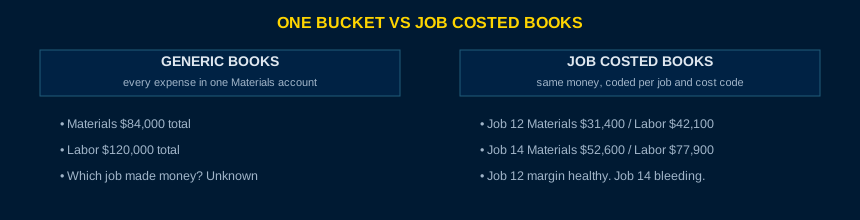
The payoff shows up in two places. During the job, cost records compared against the estimate expose overruns while there is still time to act: a framing package running 20 percent over its code in week three is a conversation with the crew, not a surprise at closeout. After the job, the cost history becomes the most valuable estimating database the company owns. Bids built on real recorded costs from similar past jobs beat bids built on gut feel, because the gut consistently forgets the small streams: fuel, fasteners, rework hours, the second dumpster.
None of this requires advanced analysis. It requires discipline at the moment of entry: every timesheet, invoice, and receipt coded to the right job and cost code, every week, without exceptions piling up in an Uncategorized account.
Retainage: Money You Earned but Cannot Bank Yet
Most commercial construction contracts hold back a slice of every progress payment, commonly 5 to 10 percent, until the project reaches completion. That holdback is retainage, and it quietly breaks any bookkeeping system that does not track it as its own category.

Consider what the records must do. You bill $100,000 and receive $90,000. If the books simply record $90,000 of income, they have erased $10,000 you earned and will someday need to collect. Multiply that across every payment on every job and a contractor can have tens of thousands of dollars of earned money that exists nowhere in its records. The correct treatment tracks retainage receivable separately from ordinary receivables, per job, until release.
It runs the other direction too. General contractors hold retainage on their subcontractors, which means the books must also carry retainage payable: money withheld from subs that is owed later. Both sides need job level records, because retainage releases are triggered by project events, not calendar dates, and chasing a forgotten release two years later is a much harder collection than invoicing it the week it comes due.
Progress Billing and the Work in Progress Record
Construction gets paid through progress billing: instead of one invoice at the end, the contractor bills monthly against a schedule of values as work advances, often on standardized pay application forms. Each application states how complete each line of work is and how much has been billed to date. Producing accurate pay applications is itself a bookkeeping function; every number on the application should trace back to recorded costs and prior billings.
The record that ties it all together is the work in progress schedule. For every open job, a WIP schedule compares three things: total costs recorded to date, total billed to date, and percent complete. Out of that comparison fall the two conditions every contractor needs to see and most financial statements hide:

Overbilling means billing has run ahead of the work. The bank balance looks great, but part of that cash represents work still owed, and spending it as profit is how companies end up funding the back half of a job out of the next job's deposits. Underbilling means the crew has built more than anyone has invoiced, which is interest free lending to the client. Neither condition is visible without job level cost and billing records maintained continuously; a WIP schedule assembled once a year from messy books is archaeology, not management.
Payroll Records Across Crews and Jobs
Construction payroll is a records problem twice over. First, the same employee routinely works on multiple jobs in one week, so the hours have to be captured and coded per job for job costing to mean anything. A bookkeeping system that posts payroll as one lump has already given up on knowing what any project's labor actually cost.
Second, public work adds a compliance documentation layer. Under the Davis-Bacon and Related Acts, contractors and subcontractors on federally funded or assisted contracts over $2,000 for construction, alteration, or repair of public buildings or public works must pay locally prevailing wages and fringe benefits, and they must document it: certified payroll records, submitted weekly on the federal WH-347 form, with worker classifications and hours that match the underlying timesheets. Many states run parallel prevailing wage regimes for state funded work. Certified payroll is pure bookkeeping: the wages, classifications, hours, and fringes must be recorded correctly in the first place, or every downstream report is wrong in writing.

Subcontractor Files: W-9s, Payments, and Lien Paperwork
Subcontractors are usually the largest cost stream a general contractor manages, and they generate their own records burden. A clean subcontractor file means a W-9 collected before the first check is written, every payment coded to the job it belongs to, and running payment totals per sub so year end information returns are a printout instead of a reconstruction project. The IRS expects businesses to keep records that support what they report, and subcontractor payments are among the first things examined when records are thin.
The same files feed lien management. Progress payments in construction typically move against lien waivers, and tracking which waivers have been collected, conditional or unconditional, partial or final, against which payments on which jobs, is record keeping. A missing waiver discovered at closeout can hold up the final payment on an entire project.
Cash Flow: The Records That See the Crunch Coming
Construction cash flow runs uphill. The contractor pays for labor and materials weeks or months before the corresponding payment arrives, retainage stretches collection past project completion, and pay when paid terms chain a subcontractor's income to the owner's payment speed. In that environment, the difference between a managed cash dip and a payroll emergency is usually nothing more than current records: an accounts receivable aging that shows exactly who owes what and how overdue it is, retainage receivable tracked by job and release condition, and accounts payable scheduled deliberately instead of paid in panic order.
None of that is forecasting wizardry. It is the boring, weekly maintenance of receivable and payable records at job level, which is exactly the maintenance that slips when the books are an afterthought.
The Records Banks and Bonding Companies Ask For
Here is the version of this argument that shows up in revenue rather than tidiness: other people's decisions about your company are made from your records. Surety companies that issue bid and performance bonds evaluate contractors on their financial statements and their job schedules, including WIP reports; lenders extending credit lines ask for the same. A contractor whose books cannot produce a credible WIP schedule and per job cost history is not just disorganized, it is presenting itself as an underwriting risk, and bonding capacity is what caps the size of public and commercial work a contractor can even bid.
The records do not need to impress anyone. They need to be complete, current, and internally consistent: billings that tie to contracts, costs that tie to jobs, retainage that ties to both. That standard is entirely a bookkeeping outcome.
What Generic Bookkeeping Gets Wrong
A competent generalist bookkeeper keeps clean books by ordinary standards and still fails a contractor, because the failures are structural rather than sloppy:
- One bucket accounting. Costs recorded by category only, with no job dimension, which makes per project profit unknowable.
- Retainage recorded as ordinary income shortfall, or not recorded at all, erasing earned money from the books.
- Lump sum payroll posting, with no allocation of hours across jobs and no structure for certified payroll documentation.
- No WIP concept. Overbilling read as profit; underbilling invisible.
- Monthly rhythm on a weekly business. Construction generates job critical paperwork daily; books updated quarterly are permanently behind the projects they describe.
None of these are fixed by better software defaults alone. Programs like QuickBooks can carry job costed construction books, but only when someone sets up the job and cost code structure and maintains the coding discipline week after week.
What Construction Bookkeeping Looks Like Done Right
The working version of all of the above is not complicated to describe. A chart of accounts built for construction, separating direct job costs from overhead. Every transaction coded to a job and cost code at entry. Payroll captured by job with the documentation structure public work requires. Subcontractor files with W-9s, coded payments, and waiver tracking. Retainage receivable and payable carried by job. Bank and credit card accounts reconciled monthly, and a WIP schedule produced monthly from records that are already current rather than rebuilt for the occasion.
Some contractors run that system in house. Many hand it to specialized construction bookkeeping services, because the structure only pays off when it is maintained every week, and the owner's week is already spoken for. Either way, the test is the same: can the books say, today, what every open job has cost, what has been billed on it, and what is still held in retainage? A construction company that can answer that runs its projects on facts. One that cannot is estimating in the dark, financing its clients by accident, and hoping the bank never asks for a WIP schedule.