Bookkeeping is the practice of recording every financial transaction a business makes. Every sale, purchase, payment, and receipt gets captured, categorized, and stored in an organized system called the books. Done well, bookkeeping tells you exactly where your money came from, where it went, and what your business is worth right now.
This guide explains bookkeeping from the ground up: what bookkeepers actually do, how double entry works, the difference between cash and accrual basis, what the work costs, and what a career in bookkeeping looks like. It is written for business owners, beginners, and anyone deciding whether to keep their own books or hand them to a professional.
Bookkeeping Explained: What It Is and Why It Matters
At its core, bookkeeping answers one question continuously: what happened to the money? A bookkeeper gathers information from bank and credit card transactions, invoices, receipts, bills, and payroll records, then records each item in the right account. The result is a complete, accurate financial record of the business.
That record matters for three reasons. First, taxes: the IRS expects businesses to keep records that support the income, deductions, and credits on their returns, and clean books make tax preparation faster and cheaper. Second, decisions: you cannot price work, hire, or borrow sensibly without knowing your real numbers. Third, survival: most cash flow problems announce themselves in the books weeks before they hit the bank account, but only if someone is keeping the books current.

Bookkeeping vs Accounting: What Is the Difference?
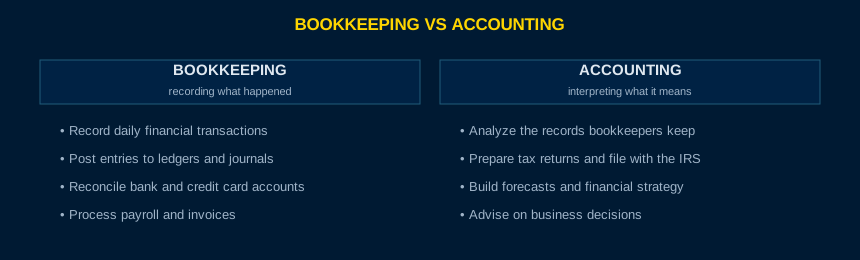
This is the most common question in the field, and the cleanest answer is this: bookkeeping records what happened; accounting interprets what it means.
The bookkeeper captures daily financial transactions, posts them to ledgers, reconciles the accounts, and produces the raw, accurate records. The accountant takes those records and works upward: analyzing performance, preparing and filing tax returns, building forecasts, and advising on strategy. Accounting depends entirely on bookkeeping. If the records underneath are wrong, every report, return, and decision built on them is wrong too.
In practice the roles overlap at small companies, where one person may do both. But when you hire, the distinction matters: a bookkeeper maintains the system week to week, while an accountant or CPA typically engages periodically for taxes, review, and planning.
What Does a Bookkeeper Do Day to Day?
A working bookkeeper's routine usually includes:
- Recording transactions. Pulling bank feeds, coding expenses to the right accounts, and entering bills and invoices.
- Invoicing and accounts receivable. Sending invoices, tracking who owes what, and following up on late payments.
- Accounts payable. Recording vendor bills and scheduling payments so nothing is missed or paid twice.
- Bank and credit card reconciliation. Matching the books against statements every month so errors and fraud surface quickly.
- Payroll support. Processing pay runs, tracking withholdings, and preparing year end W-2 and 1099 forms.
- Reporting. Producing the monthly profit and loss statement, balance sheet, and any reports the owner or accountant needs.
The common thread is accuracy and rhythm. Bookkeeping is not a once a year scramble; it is a weekly and monthly discipline that keeps the financial records trustworthy at all times.
Single Entry vs Double Entry Bookkeeping
There are two recording systems, and the choice shapes everything downstream.
Single entry bookkeeping
Single entry works like a checkbook register: each transaction is recorded once, as money in or money out. It is simple and can be adequate for a very small, cash only operation with no inventory, no loans, and no employees. Its weakness is that it cannot prove itself. There is no built in check that catches missing or duplicated entries.
Double entry bookkeeping
Double entry records every transaction twice, as a debit in one account and a matching credit in another. Invoice a customer for $500 and the books show two things at once: accounts receivable goes up by $500, and revenue goes up by $500.

Because debits must always equal credits, the system continuously audits itself: if the trial balance does not balance, something is wrong and you know to look. Virtually all bookkeeping software uses double entry under the hood, and any business with employees, inventory, credit sales, or loans should be on it.
Ledgers, Journals, and the Chart of Accounts
Three structures organize the books:
- The journal is the chronological record: transactions written down in order as they happen, each with its date, amount, and accounts affected.
- The general ledger reorganizes those journal entries by account, so you can see everything that happened to Cash, or Revenue, or Accounts Payable in one place. Ledgers are the master record of the business.
- The chart of accounts is the index: the full list of accounts the business uses, organized into assets, liabilities, equity, income, and expenses. A well designed chart of accounts is what makes reports meaningful, because transactions can only be as organized as the categories they land in.
Cash Basis vs Accrual Basis
Beyond how you record, there is the question of when. The two timing methods:
Cash basis records revenue when money is received and expenses when money is paid. It is simple and mirrors the bank account.
Accrual basis records revenue when it is earned and expenses when they are incurred, regardless of when cash moves. If you complete work in January and get paid in March, accrual books show January revenue.
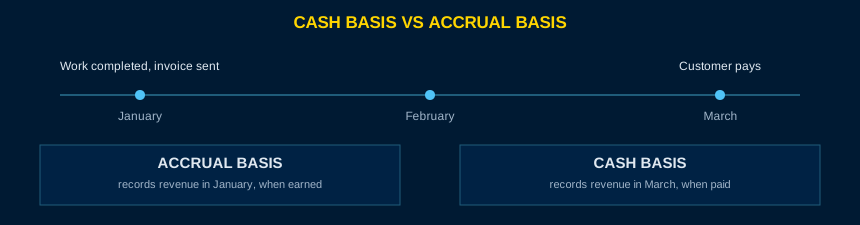
Accrual gives a truer picture of performance, especially where work and payment are separated by weeks or months, and it is why industries with long project timelines lean on accrual and job based records. Many small businesses start on cash basis for simplicity and move to accrual as they grow, take on credit, or need financing.
Accounts Payable, Accounts Receivable, and Reconciliation
Three processes carry most of the day to day weight:
Accounts receivable (AR) is money owed to you. Good AR bookkeeping means invoices go out promptly, aging is watched, and late payers get followed up before the debt goes stale. Weak AR is the most common self inflicted cash flow wound in small business.
Accounts payable (AP) is money you owe. Good AP bookkeeping records every bill when it arrives, schedules payment strategically, and preserves your vendor relationships and credit.
Reconciliation is the monthly proof. Every bank and credit card account gets matched line by line against the books. Reconciliation is where duplicate charges, bank errors, missed entries, and fraud get caught. Books that are not reconciled are not really books; they are notes.
Bookkeeping Software and Tools
Modern bookkeeping runs on accounting software. QuickBooks is the most widely used option for small business in the United States, and alternatives such as Xero, FreshBooks, and Wave cover similar ground: bank feeds that import transactions automatically, invoicing, payroll integrations, and one click financial reports.
Two honest caveats. First, software automates recording, not judgment: a bank feed will happily code a transaction to the wrong account forever if nobody checks it. Second, setup determines everything. The chart of accounts, tax settings, and workflows have to match how the business actually operates, which is why many owners have a professional set up the file even when they plan to run it themselves.
In House, Outsourced, and Virtual Bookkeeping
There are three ways to get the work done:
- Do it yourself or in house. Full control, lowest cash cost, highest time cost. Works while volume is small; tends to break down as transactions grow and the owner's time gets more valuable elsewhere.
- Outsourced bookkeeping. An external professional or firm keeps the books for a flat monthly fee. You get trained eyes, consistency, and time back, without the salary and benefits of a hire.
- Virtual bookkeeping. The same relationship, done fully remotely through cloud software and shared document access. Since the books live online anyway, geography stops mattering, and the field has moved heavily this direction.
Specialization matters more than location. Industries with unusual money flows need bookkeeping and accounting services built for those flows. Construction is the clearest example: job costing, retainage, progress billing, and certified payroll do not exist in a generic retail ledger, which is why specialized construction bookkeeping services exist as their own discipline.
How Much Does Bookkeeping Cost?
Cost scales with transaction volume and complexity. A tiny cash basis operation might spend very little beyond software fees. As volume, employees, and projects grow, outsourced bookkeeping typically moves to a flat monthly rate agreed up front. For a sense of real numbers in one specialized field, our construction bookkeeping services pricing runs from $400 to $2,500 per month depending on active projects, payroll complexity, and transaction volume, and generalist small business bookkeeping tends to sit in a similar band.
The comparison that matters is not the fee against zero; it is the fee against the cost of doing it yourself badly: missed deductions, late invoices, surprise cash crunches, and the hours you did not spend on billable work.
Bookkeeper Careers: Education, Certification, and Pay
Bookkeeping is also a career, and a large one. According to the U.S. Bureau of Labor Statistics, bookkeeping, accounting, and auditing clerks held about 1,613,400 jobs in 2024, with median pay of $49,210 per year ($23.66 per hour). Typical entry level education is some college with no degree required, plus moderate on the job training. The BLS projects employment to decline about 6 percent from 2024 to 2034 as software automates routine entry, which is exactly why the value in the field keeps shifting from data entry toward judgment: setup, review, reconciliation, and industry specific expertise.
Certification is optional but respected. The American Institute of Professional Bookkeepers and the National Association of Certified Public Bookkeepers both offer credentials, and software vendors offer their own, such as the QuickBooks ProAdvisor program. For anyone hiring, certification signals commitment; for anyone practicing, it is a credibility shortcut, not a legal requirement, since bookkeeping in the United States is an unregulated profession.
Keeping Better Books: Where to Start
Whatever the size of the operation, the fundamentals are the same. Separate business and personal money completely. Pick double entry software and set up a chart of accounts that matches how the business really runs. Record transactions weekly, not quarterly. Reconcile every account every month. Keep the source documents, because the IRS recordkeeping rules expect the paper trail behind the numbers. And the moment the books start costing you more in time and errors than a professional would charge, hand them off: accurate books are one of the few business investments that pay for themselves in both directions, saving tax money and enabling better decisions at once.